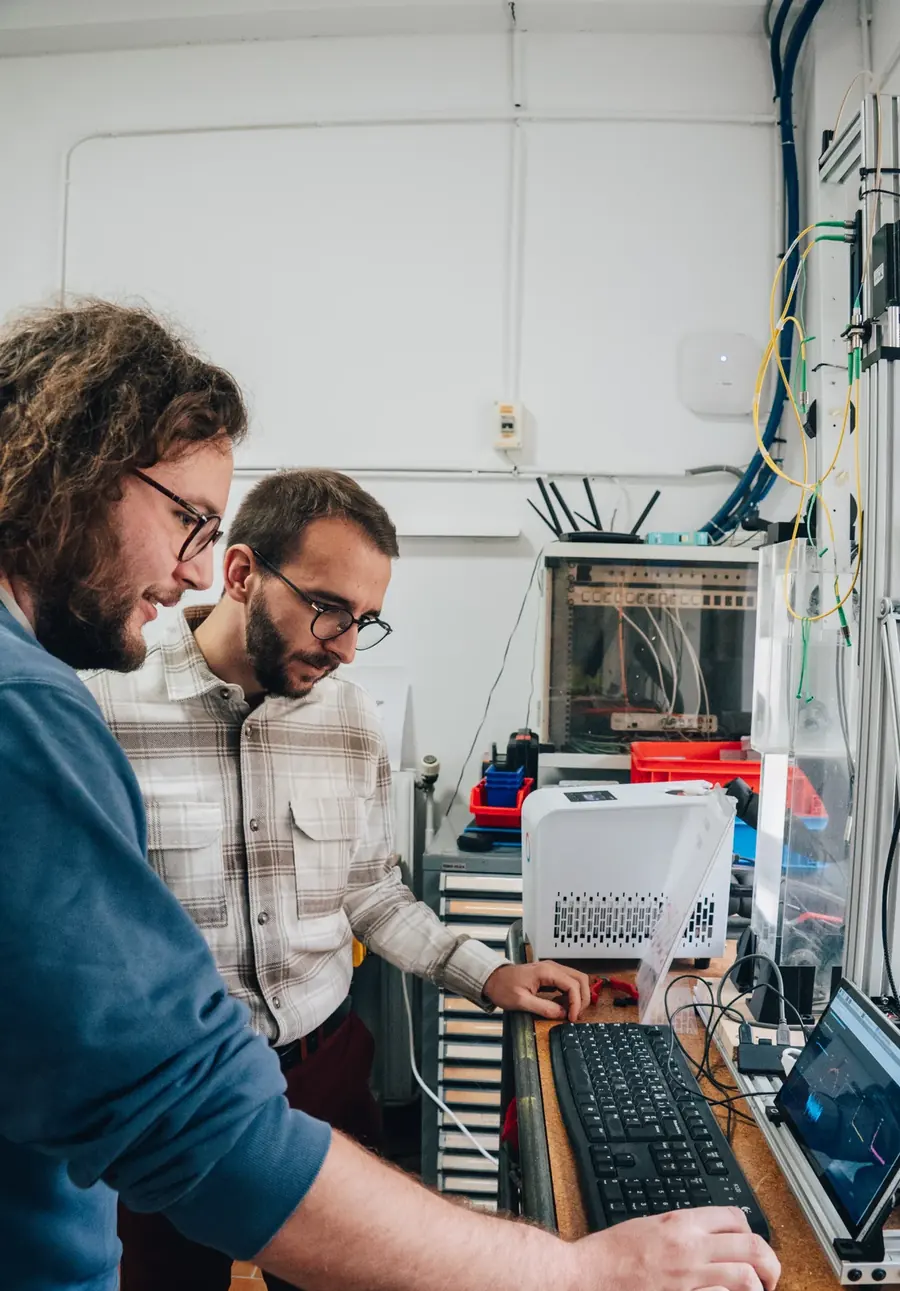
TRL 1 to 3
From principle to proof of concept
- What it proves
- A principle can be harnessed and a first demonstration obtained in controlled conditions.
- What it does not prove
- That the solution is robust, integrable or manufacturable.


Our method
Reducing risk step by step: tackle first what could make the project fail, and decide on facts rather than deliverables.
In short
Innowide's method means steering a deeptech project through evidence rather than deliverables. We first identify the critical hypotheses that could make the project fail, then test them in short loops, with prototypes designed as decision-making instruments. Each cycle produces data that lets you continue, change course or stop. We apply this approach, rooted in agility and adapted to hardware, between TRL 2 and 6.
Principle #1
At the start, a deeptech project does not first need a detailed master schedule, but an explicit reading of its critical uncertainties. We distinguish five families.
Is the problem important enough? Does the solution bring a significant gain?
Can the solution reach the expected performance? Which physical limits could block it?
Does it fit into the wider system? Are interfaces, environment and safety manageable?
Can it be manufactured, qualified, sourced, maintained and scaled?
Do we have the skills, the sponsor, the decision pace and the governance to move forward?
Principle #2
Deliverables are useful, but they become misleading when they are not tied to any evidence. A prototype can be delivered without answering the right question.
Principle #3
A simple but demanding chain: it avoids both the overly abstract project and the overly busy one.
What ambition are we serving, for what concrete impact?
Which deadlocks could invalidate that ambition?
What minimal artefact (prototype, test bench, simulation) lets us remove them quickly?
What will we conclude from the result?
At the end of every iteration, the same short document: what we tested, what we measured, the maturity level reached, what holds, what doesn't, the decision we recommend and what it commits you to. It ends with a proposal for the next iteration, with its expected evidence and price. When the measurement says stop, we write it down.
Our approach
We tackle first what could make the project fail. Each cycle develops, tests and validates the critical points before more resources are mobilised.
Pinpoint what could make the project fail and state the critical hypotheses to test.
Explore the technical options and design candidate solutions.
Quickly build prototypes designed as decision-making instruments, not finished products.
Test, measure, then deliver a decision file: continue, redirect or stop.
A prototype is not a mock-up: it is a decision-making instrument.
Agile for Hardware
Copying software practices often leads to a dead end in deeptech. Agile principles remain powerful; it is the tactics that must be adapted to hardware constraints.
Not "what will we do?" but "what will we make testable together?"
Do not confuse speed of building with speed of learning.
Synchronise disciplines when it is essential, not all the time.
Bring in early what the real world accepts, rejects or transforms.
TRL scale
The TRL (Technology Readiness Level) scale describes a technology's maturity in nine levels, from observing a principle (TRL 1) to operation in real conditions (TRL 9). Innowide works between TRL 2 and 6, where critical points still need to be proven.
TRL 1 to 3
TRL 4 to 5
TRL 6 to 7
TRL 8 to 9
Producing at acceptable cost, rate and quality: that is what MRL covers.
A building block mature as a component can remain immature as a system.
The sector's regulatory or certification requirements.
What users and the operational environment actually accept.
What about your organisation? Measure your maturity on hardware agility, technological uncertainty or prototyping in 5 minutes.
Take the self-assessmentFAQ
Organising a project around what has been learned rather than what has been produced. A deliverable shows that something exists; evidence reduces an uncertainty and lets you decide: a measurement, a test, a comparison or an integration trial.
A way of applying agile principles (value, feedback, adaptation) to hardware and deeptech projects while adapting the tactics: initial framing before iterating, prototypes designed as decision-making instruments, and two rhythms combining short disciplinary sprints and system-level iterations.
Because a sprint built around a list of tasks does not speed up learning. In hardware, a useful cycle is built around an integration goal, a prototype strategy, deliberate alignment between disciplines and a reality check.
The TRL (Technology Readiness Level) scale measures a technology's maturity in nine levels, from observing a principle (TRL 1) to operation in real conditions (TRL 9). Innowide works between TRL 2 and 6.
No. TRL measures technology maturity, not manufacturing (MRL), integration, qualification or usage maturity. A project can be advanced in TRL and still very immature in terms of industrialisation.
A prototype designed to reduce a priority uncertainty, not to show progress. It answers a specific question: validating a principle, comparing two options, measuring a performance or revealing an integration constraint.
Further reading (in French)
Technology to validate
Turn hypotheses into concrete evidence before you decide.
Discover the expertiseProject unclear or stuck
Identify the critical priorities and get the project moving again.
Discover the expertiseMove faster
Accelerate with technological building blocks explored and matured upstream.
Discover the expertise30 minutes to identify your critical hypotheses and the first evidence to produce.
Talk to an expert